
The mehndi is usually the event families spend the least time planning, because so much attention goes into the main wedding day. That’s a mistake – a good Mehndi night has its own requirements, and booking the wrong space for it is a common regret we hear about from families who’ve been through it before.
What Makes a Good Mehndi Venue
A Mehndi isn’t a scaled-down wedding reception venues. It’s its own thing, and it needs a few specific things to actually work.
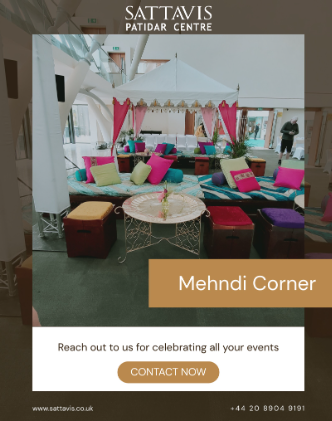
Colour. Mehndi decor tends to be brighter and more layered than a wedding reception – think yellows, oranges, pinks and mirror work rather than the more formal palette of the main day. A room that’s already heavily styled in one direction, or one with awkward lighting that fights against decor, makes this harder than it needs to be. A more neutral base room gives your decorator something to actually work with.
Floor space for dancing. Mehndi nights are informal and dance-heavy from fairly early on, often well before the henna itself even starts. You need open floor space that isn’t dominated by fixed round tables so guests can move between the henna artists’ seating area and a dance space without the whole event feeling cramped.
Catering flexibility. Mehndi catering is usually more casual than a wedding breakfast – food stations, chaat, and snacks people can eat standing up while getting their henna done, rather than a formal three-course sit-down. A venue that only really does formal plated service will fight you on this.
Why the Dhamecha Auditorium Suits Mehndi Events
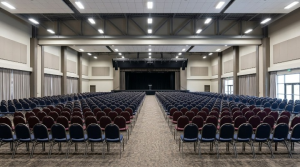
The Dhamecha Hall/Auditorium at Sattavis Patidar Centre holds 250 for seated dining or 300 theatre-style, which sits neatly in the range most Mehndi events actually need – big enough for extended family and friends, without the scale (or cost) of a full wedding-sized room.
It has its own standalone kitchen, which matters more than it sounds like it should. It means Mehndi catering – food stations, live counters, and more relaxed serving times as guests come and go for henna – can run independently, without competing for kitchen time or staff with whatever else might be happening elsewhere on site that day. And because it’s a separate space from the Mostyn and IK suites, you get a room sized and priced for a 150–300 guest evening event rather than paying for a hall built for 900.
Booking the Mehndi and the Main Wedding at the Same Venue
One of the more practical reasons to book your mehndi at the same venue as your main wedding is that it removes an entire layer of logistics — no separate load-in for decorators, no briefing a second venue’s team on your running order, and no guests getting confused about which building to turn up to on which night.
At Sattavis, the Dhamecha Auditorium can be booked for your Mehndi while the Mostyn or IK Suite is booked separately for your ceremony and reception, sometimes on consecutive days. If you’re also planning a civil ceremony as part of your celebrations, it’s worth reading our guide to hosting your civil ceremony at Sattavis alongside this one, since the two often get planned together.
Planning Checklist for Your Mehndi Event
A short list worth working through before you book anything:
- Confirm your guest count – Mehndi numbers are often smaller than the wedding day itself, but not always.
- Decide on seating for the henna artists separately from general guest seating.
- Check the room allows outside decorators, or ask about in-house options.
- Confirm catering style – food stations and casual serving usually work better than formal plated service.
- Ask about timing flexibility, since Mehndi events often run later into the evening than a formal reception.
- Check parking provision if you’re expecting a large number of guests to drive.