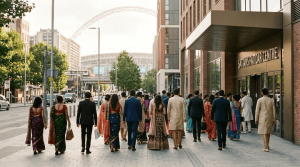

If you’ve started looking for an Asian wedding venue in Wembley, you’ll already know the search isn’t as simple as typing “wedding hall near me”. A Gujarati wedding needs a venue for Garba the night before. A Hindu ceremony needs floor space for a mandap and a fire pit that’s actually safe to use indoors. A Patidar family might want all of it under one roof across two or three days, without shuttling three hundred guests between three different buildings. Generic wedding venues rarely think this far ahead. We do, because it’s what we’ve been doing since the day the doors opened.
Sattavis Patidar Centre sits three minutes’ walk from Wembley Park station, and it was built by and for the Shree Sattavis Gam Patidar Samaj (Europe) community. That’s not a marketing line – it’s the reason the building exists. When we talk about hosting Gujarati and Hindu weddings, we’re not describing a service we bolted on to compete for search traffic. It’s the reason there’s a venue here at all.
What Makes a Venue Right for a South Asian Wedding
South Asian weddings ask for more of a building than most Western wedding venues are built to handle. Two things come up again and again when families call us.
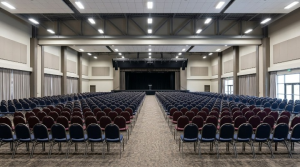
Capacity for 300–900 guests. A lot of London venues top out at 150–250 for a seated dinner, which sounds generous until you start adding up extended family, community elders, and the friends of friends who somehow always end up on the list. Our Mostyn Suite seats 500 for a formal dinner, holds 700 theatre-style, and can take 900 standing. That’s the difference between telling half your guest list they can’t come and actually hosting the wedding you planned.
Space for multi-day, multi-event celebrations under one roof. Sangeet one evening, Mehndi the next, ceremony and reception on the third day – South Asian weddings are rarely a single event. Moving a 400-person guest list between three separate venues over three days is expensive and, frankly, exhausting to organise. With the Mostyn, IK, Aristel and Dhamecha suites plus the Atrium Lobby, we can run different events in different rooms on the same site, sometimes on the same day, without one celebration bleeding into the next.
Gujarati and Patidar Wedding Traditions at Sattavis
This is where the venue’s history actually matters. Sattavis Patidar Centre was established by the Shree Sattavis Gam Patidar Samaj, a community organisation with roots going back generations in the UK’s Gujarati diaspora. Staff here have been part of Garba nights, Navratri celebrations and Patidar community weddings for years – not as an events company learning the customs from a brief, but as people who grew up around them.
That matters practically, not just sentimentally. It means we know a Garba needs a sprung or reasonably forgiving floor, not a hard marble surface that guests will be limping off after three hours of dancing. It means we know the difference between a small family Sangeet and a full community Garba that might pull in six hundred people during Navratri season — and we book and staff accordingly. During Navratri, the Mostyn Suite regularly hosts community Garba nights on a scale that most function rooms in London simply weren’t designed for.
Ask a generic hotel function suite to host a Patidar wedding, and you’ll usually get a room and not much else – no real feel for the running order, no sense of when the Jaimala happens relative to the meal service, no understanding of why the DJ needs to know the difference between a Sangeet playlist and a straightforward wedding reception one. That’s the gap between a venue that rents you a room and one that’s actually part of the community it’s serving.
Hindu Wedding Ceremonies: Sacred Fire, Mandap and Guest Flow
A Hindu wedding ceremony has practical requirements a generic events venue often gets wrong. The mandap needs to be positioned so every guest has a sightline to the fire, not just the front three rows. There needs to be safe, ventilated space for the havan, properly managed rather than treated as an afterthought squeezed next to the bar. And the room needs to handle the shift from ceremony to reception without four hundred people queuing at a single set of doors.
We stage mandaps in the Mostyn Suite regularly enough that it’s become second nature – positioning for sightlines, working with your priest or pandit on space and timing, and managing the changeover between ceremony seating and reception layout without a two-hour gap where guests are left standing around wondering what happens next. Guest flow is one of those things nobody notices when it’s done properly, and everybody notices when it isn’t.
Civil Ceremonies, Mehndi and Pre-Wedding Events
Not every celebration is the big Hindu or Sikh-style ceremony with mandap and fire. Plenty of couples we work with also want a legally binding civil ceremony, either as the only ceremony or alongside religious rites – and there are specific rules around giving notice of marriage and who can conduct it that catch people out if they leave it too late. We’ve written a dedicated guide on hosting a civil ceremony at Sattavis that walks through exactly what’s required and when to book your registrar.
The Mehndi is its own event again – usually more relaxed, more colourful, and often the one families spend the least time planning because so much energy goes into the main day. We’ve put together a separate guide to planning a Mehndi event that covers layout, seating for the artists, and timing if you’re running it back-to-back with a Sangeet.
Parking, Transport and Accessibility for Large Guest Lists
Ask anyone who’s organised a 400-guest wedding in London what actually kept them up at night, and parking is near the top of the list more often than the flowers.
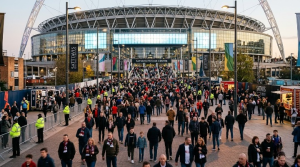
We have 220 free, on-site managed parking spaces – not a shared car park three streets away with a ten-minute walk in heels, but spaces on the grounds, managed on the day so guests aren’t circling for twenty minutes looking for a gap. For guests coming by public transport, Wembley Park station is a three-minute walk, served by both the Metropolitan and Jubilee lines, which puts central London within easy reach for out-of-town family staying in hotels nearby.
For a wedding of 500 or more guests, that combination – genuine free parking plus a step-free tube connection – solves a logistics problem that a lot of venues in more central postcodes simply can’t.
Accessibility matters too, and it’s easy to overlook until an elderly relative or a guest using a wheelchair turns up on the day. The venue has wheelchair access throughout the main suites, so you’re not having to apologise to grandparents about steps or narrow doorways in the middle of a wedding.
Choosing Between the Mostyn, IK and Aristel Suites
Different events call for different rooms, and getting this wrong is one of the more expensive mistakes couples make – either paying for far more space than they need, or squeezing a big Garba into a room that was never going to fit it.
As a rough guide: the Mostyn Suite is the one to look at for a main wedding reception with over 400 guests or a large Garba night. The IK Suite works well for a Sangeet, Mehndi, or a wedding in the 200–500 range that doesn’t need the full scale of the Mostyn. The Dhamecha Hall suits smaller, more intimate family functions – a registry-style civil ceremony, an engagement, or a pre-wedding puja.